For decades, the standard blueprint for business security was simple: build a high wall around your office network. We called this the "castle and moat" strategy. If you were inside the office, you were trusted; if you were outside, you were blocked. You had a firewall at the door and perhaps a VPN for the occasional remote traveler.
But as we navigate through 2026, that castle has been vacated. Your employees are at home, in coffee shops, or showing properties across the city. Your data isn't in a server closet; it’s in the cloud, spread across platforms like Microsoft 365, Salesforce, and specialized industry tools.
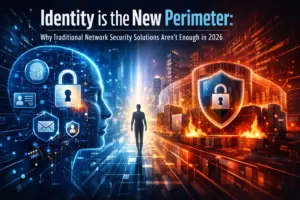
In this decentralized world, the traditional network perimeter has effectively dissolved. The new perimeter isn't a physical location or a specific router: it is Identity. Whether a person is sitting in your headquarters or a hotel lobby, their credentials and their verified identity are the only things standing between your sensitive data and a catastrophic breach.
The Dissolution of the Office Wall
The shift toward identity-based security didn't happen overnight, but it has reached a tipping point. In 2026, the hybrid work model is no longer an "alternative": it is the standard. For fast-growing small businesses and real estate firms, this flexibility is a competitive advantage. It allows you to hire the best talent regardless of location and stay mobile enough to meet clients wherever they are.
However, this mobility creates a massive security gap for those still relying on legacy systems. Traditional network security solutions were designed for a world where we knew exactly where the user was. Today, your "network" is wherever your employees happen to be.
When your team accesses company data from a dozen different zip codes on various devices, the traditional firewall becomes a secondary defense. It can protect the physical office, but it cannot follow your team into the field. This is why cloud security has moved from an IT "extra" to a core business necessity.

Why Firewalls Aren’t Enough (But Still Necessary)
It is a common misconception that identity-based security replaces the firewall entirely. At Degarmo Technologies, we view firewalls as a foundational layer, but they are no longer the primary layer.
Think of a firewall like a security guard at the front gate of a gated community. They check cars coming in, which is great for keeping out obvious intruders. But once a "resident" (or someone with a stolen gate clicker) is inside, the guard usually stops watching. If that person starts breaking into houses within the community, the gate guard is none the wiser.
In 2026, attackers don't "break in": they "log in." They use stolen credentials, sophisticated phishing, or AI-driven social engineering to bypass the front gate entirely. Once they have a valid username and password, they are trusted by the network. This is why traditional solutions fail: they focus on the where (the network) rather than the who (the identity).
To truly protect your business, you need a system that monitors the resident's behavior even after they’ve passed the gate. This requires a shift toward Managed Security Services that prioritize identity verification at every single step.
The Components of Identity-First Security
If identity is the new perimeter, how do you secure it? It’s more than just a complex password. Modern businesses must implement a robust Identity and Access Management (IAM) framework.
- Multi-Factor Authentication (MFA): In 2026, standard MFA (getting a text code) is often insufficient due to "SIM swapping" and phishing. We now implement "Phishing-Resistant MFA," using hardware keys or biometric verification (like FaceID or fingerprints) to ensure the person logging in is physically who they say they are.
- Single Sign-On (SSO): SSO allows employees to use one secure set of credentials for all their apps. This reduces "password fatigue" and gives business owners a single "kill switch" to revoke all access instantly if an employee leaves or a device is lost.
- Identity Threat Detection and Response (ITDR): This is the next frontier. ITDR systems use AI to spot unusual patterns. If an agent in Denver logs in at 9:00 AM, and then their credentials are used to access a database from London at 9:05 AM, the system automatically flags and blocks the session.
- Least Privilege Access: This principle ensures that employees only have access to the specific data they need for their job. A marketing assistant shouldn't have access to the company’s payroll files or sensitive escrow documents.

Zero Trust: The "Never Trust, Always Verify" Mindset
The transition to identity-based security is fueled by the Zero Trust architecture. The name sounds cynical, but it is actually the most practical way to run a modern business.
In a Zero Trust environment, the system assumes that every request to access data is a potential threat until proven otherwise. It doesn't matter if the request comes from inside the office or from the CEO’s home laptop. The system verifies:
- Who is requesting access?
- What device are they using (is it a managed company laptop or a random unpatched phone)?
- Where are they connecting from?
- Does their behavior align with their typical role?
For real estate firms, where agents frequently use personal devices and work on the fly, Zero Trust is a lifesaver. It ensures that even if an agent's personal phone is compromised, your core business data remains isolated and protected. This approach is central to our IT support management philosophy: we build security into the workflow, not as a hurdle in front of it.
The 2026 Threat Landscape: AI and Deepfakes
Why is the shift to identity so urgent right now? Because the attackers have upgraded their tools. In 2026, we are seeing a massive rise in AI-driven attacks. Cybercriminals can now use "Deepfake" technology to impersonate a business owner’s voice or face in a video call, tricking an employee into transferring funds or revealing credentials.
Traditional network security cannot stop a deepfake. A firewall doesn't know that the "CEO" on the Zoom call is an AI-generated fraud. However, identity-based security can stop the fallout. If your systems require a physical security key or a biometric "liveness" check to authorize a sensitive transaction, the attacker’s deepfake becomes useless. By centering your defense on the identity, you create a roadblock that AI-driven social engineering can't easily bypass.

Why Real Estate and Fast-Growing SMBs Are Targets
If you are running a fast-growing small business, you might think you are "too small" to be a target. The reality is the opposite. Small businesses are often viewed as "soft targets" because they lack the massive IT departments of Fortune 500 companies.
Real estate firms are particularly attractive to hackers because they handle large sums of money and vast amounts of Personal Identifiable Information (PII). A single successful breach can result in diverted escrow funds, identity theft for clients, and irreparable damage to your reputation.
At Degarmo Technologies, we specialize in helping these specific industries bridge the gap. We understand that you don't have time to become a cybersecurity expert: you need to focus on closing deals and scaling your operations. We take the complexity of cloud solutions and identity management and turn them into a seamless, "always-on" background process.
Strategic Growth Requires Secure Foundations
Security is often viewed as a "cost center," but in 2026, it is a growth enabler. When your identity perimeter is secure, you can scale your business with confidence. You can hire remote teams, adopt new cloud tools, and enter new markets without wondering if your back door is left open.
Implementing these changes: moving from a network-centric view to an identity-centric view: can feel overwhelming. There are hundreds of vendors and thousands of "buzzwords" to navigate. That is where we come in. Degarmo Technologies simplifies this transition. We align your security posture with your business goals, ensuring that your technology supports your growth rather than creating a liability.
Explore how our managed security services can transform your business into a modern, identity-first organization. Whether you need to meet strict industry compliance standards or simply want the peace of mind that your data is safe, we are here to guide you.
Conclusion: Secure Your "Who," Not Just Your "Where"
The world has changed, and the way we protect our businesses must change with it. The office walls are gone, the data is in the cloud, and the attackers are smarter than ever.
By making Identity your new perimeter, you aren't just checking a box for IT security; you are building a resilient business that is ready for the future. You are ensuring that no matter where your team goes or how fast you grow, your most valuable assets remain under your control.
Don't wait for a breach to realize your firewall isn't enough. Contact Degarmo Technologies today for a consultation, and let's build a security strategy that moves as fast as you do.